Introduction
One of the biggest debates in web design is whether website templates are truly professional. Many business owners believe that only a custom-built website can create a strong online presence, while others rely on templates to launch their websites quickly and affordably.
The truth is that modern website templates have evolved dramatically. Today’s premium templates are fast, responsive, customizable, SEO-friendly, and capable of powering everything from small business websites to enterprise-level online stores.
If you’ve ever wondered whether using a template is the right choice for your business, this guide explains everything you need to know.
What Is a Website Template?
A website template is a pre-designed website layout that serves as the foundation for building a website. Instead of designing every page from scratch, developers and designers customize an existing framework.
Think of it like buying a fully furnished house. The walls, rooms, and structure already exist—you simply decorate it to match your personal style.
Website templates typically include:
- Homepage
- About page
- Services page
- Portfolio
- Blog
- Contact page
- Navigation menu
- Footer
- Mobile responsiveness
- Typography
- Color schemes
Templates can be built using HTML/CSS, WordPress, Elementor, React, Next.js, Bootstrap, Tailwind CSS, Webflow, Wix, Shopify, or many other platforms.
Why Website Templates Have Become So Popular
Businesses no longer want to wait months before launching online.
Templates provide a faster route from idea to live website.
Instead of spending weeks creating every section manually, developers simply customize an existing layout.
This allows businesses to:
- Launch faster
- Reduce development costs
- Focus on marketing
- Improve customer experience
- Test business ideas quickly
For startups, this speed can make the difference between success and failure.
Benefits of Using Website Templates
1. Faster Development
Building from scratch takes weeks.
Templates can reduce development time by over 70%.
Instead of creating:
- Navigation
- Hero section
- Cards
- Forms
- Buttons
- Pricing tables
Everything already exists.
Developers only replace content, branding, and images.
2. Lower Cost
Custom websites require:
- UI designers
- UX researchers
- Frontend developers
- Backend developers
- QA testers
Templates eliminate much of that cost.
Small businesses can obtain professional websites without spending thousands of dollars.
3. Mobile Responsive
Modern templates are designed for:
- Desktop
- Tablet
- Smartphone
Responsive layouts automatically adjust to every screen size.
This improves:
- User experience
- Google rankings
- Conversion rates
4. SEO-Friendly
Most modern templates follow SEO best practices:
- Semantic HTML
- Fast loading
- Responsive design
- Image optimization
- Clean URLs
- Proper heading structure
- Internal linking support
When combined with quality content, templates can rank just as well as custom websites.
5. Professional Design
Years ago, templates looked generic.
Today’s premium templates feature:
- Smooth animations
- Glassmorphism
- Dark mode
- Modern typography
- Beautiful gradients
- Interactive elements
- Professional spacing
Many are difficult to distinguish from custom-designed websites.
6. Easy Customization
Templates are no longer “one-size-fits-all.”
You can easily customize:
- Colors
- Fonts
- Logos
- Images
- Icons
- Layouts
- Animations
- Sections
Most page builders allow editing without writing code.
7. Better User Experience
Professional templates are built with user behavior in mind.
They include:
- Clear navigation
- Fast loading
- Strong call-to-action buttons
- Good readability
- Proper spacing
- Logical layouts
This helps visitors find information quickly.
Are Website Templates Really Professional?
Absolutely.
Many global companies started with templates before investing in custom solutions.
Professionalism depends less on the template itself and more on:
- Branding
- Content quality
- Performance
- User experience
- Customization
- Functionality
A poorly designed custom website can perform worse than a well-customized template.
When Templates Are the Best Choice
Templates are ideal for:
- Small businesses
- Freelancers
- Personal portfolios
- Agencies
- Blogs
- Restaurants
- Schools
- Churches
- NGOs
- Online stores
- Startups
- Landing pages
These projects often benefit more from speed and affordability than from entirely custom development.
When a Custom Website Is Better
A custom website is recommended when your business requires:
- Complex dashboards
- Banking systems
- Hospital management
- Airline booking
- ERP systems
- Government portals
- Social media platforms
- AI applications
- Custom databases
- Enterprise software
These projects require unique architecture beyond the capabilities of standard templates.
Common Myths About Website Templates
Myth 1: Templates Look Cheap
Not anymore.
Premium templates often feature award-winning designs and modern aesthetics.
Myth 2: Templates Are Slow
Performance depends on optimization.
A properly optimized template can load in under two seconds.
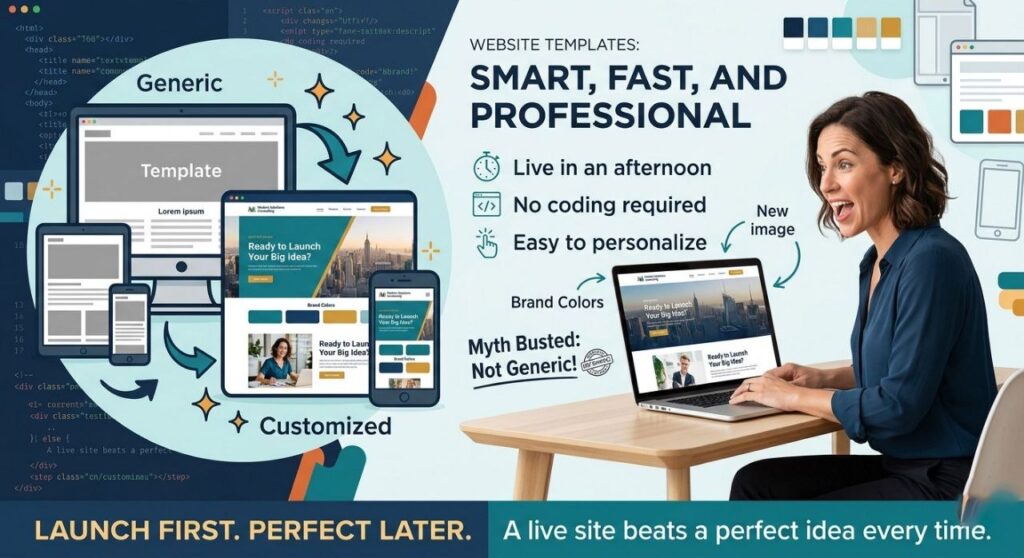
Myth 3: Everyone Will Have the Same Website
Templates are highly customizable.
Changing colors, layouts, typography, images, animations, and branding creates a unique experience.
Myth 4: Templates Cannot Rank on Google
Google ranks websites based on quality, relevance, speed, mobile usability, and user experience—not whether the site started from a template.
Choosing the Right Website Template
Before selecting a template, consider the following:
Responsive Design
Ensure it works on all devices.
Speed
Choose lightweight templates with minimal unnecessary code.
SEO Structure
Look for semantic HTML and clean page structures.
Customization
The template should allow easy editing without extensive coding.
Regular Updates
Templates maintained by active developers receive security fixes and compatibility improvements.
Browser Compatibility
Test across Chrome, Firefox, Safari, and Edge.
Accessibility
Ensure the design supports keyboard navigation, readable fonts, sufficient color contrast, and descriptive image alt text.
Popular Website Template Technologies
WordPress Templates
Ideal for blogs, business websites, and online stores.
Popular themes include:
- Astra
- Kadence
- GeneratePress
- Blocksy
- OceanWP
Bootstrap Templates
Perfect for developers who want responsive HTML websites.
Benefits include:
- Responsive grid
- Reusable components
- Easy customization
Tailwind CSS Templates
Tailwind offers modern utility-first styling.
Advantages include:
- Smaller CSS files
- Faster development
- Clean code
- Modern UI
React Templates
React templates are excellent for interactive web applications.
Common uses include:
- SaaS
- Dashboards
- Portfolios
- Admin panels
Next.js Templates
Next.js combines React with powerful performance features such as server-side rendering, static site generation, and improved SEO.
Shopify Templates
Designed for eCommerce stores.
Features include:
- Product pages
- Shopping cart
- Payment integration
- Inventory management
Best Practices for Customizing Templates
To make a template truly yours:
- Replace all placeholder text.
- Use original images and graphics.
- Apply your brand colors.
- Add your logo.
- Improve typography.
- Optimize images.
- Remove unnecessary plugins.
- Compress CSS and JavaScript.
- Add structured data.
- Install SSL certificates.
- Create custom icons.
- Improve page speed.
- Write unique content.
The goal is to transform a template into a website that reflects your brand rather than appearing generic.
Website Templates vs. Custom Development
| Feature | Website Template | Custom Website |
|---|---|---|
| Cost | Lower | Higher |
| Development Time | Days | Weeks or Months |
| Flexibility | High | Unlimited |
| SEO | Excellent | Excellent |
| Performance | Excellent (when optimized) | Excellent |
| Maintenance | Easier | More complex |
| Best For | Small to medium projects | Large, highly specialized systems |
The Future of Website Templates
Artificial Intelligence is changing how templates are created.
Modern builders can now:
- Generate layouts automatically.
- Suggest content.
- Create images.
- Optimize SEO.
- Improve accessibility.
- Personalize user experiences.
- Recommend color palettes.
- Generate responsive sections instantly.
This means templates are becoming even smarter and more powerful.
Final Thoughts
Website templates are no longer shortcuts—they are strategic tools that help businesses launch faster, reduce costs, and maintain a professional online presence. Whether you’re a freelancer building a portfolio, a startup validating a new idea, or a business expanding your digital footprint, a well-chosen and thoughtfully customized template can deliver excellent results.
The key is not simply choosing a template, but tailoring it with your own branding, compelling content, optimized performance, and a user-focused experience. When these elements come together, visitors won’t be asking whether your website started from a template—they’ll remember the value your brand delivered.
If you’re looking to establish a modern, high-performing website without the lengthy timeline and expense of custom development, a professionally customized website template is one of the smartest investments you can make.